When most people think about augmented reality glasses, they often picture immersive 3D graphics or contextual information layered onto the physical world. But at Magic Leap, we know those visuals are only as good as the system behind them. To make digital content feel clear, stable, and natural, every part of the display stack needs to be designed to work together.
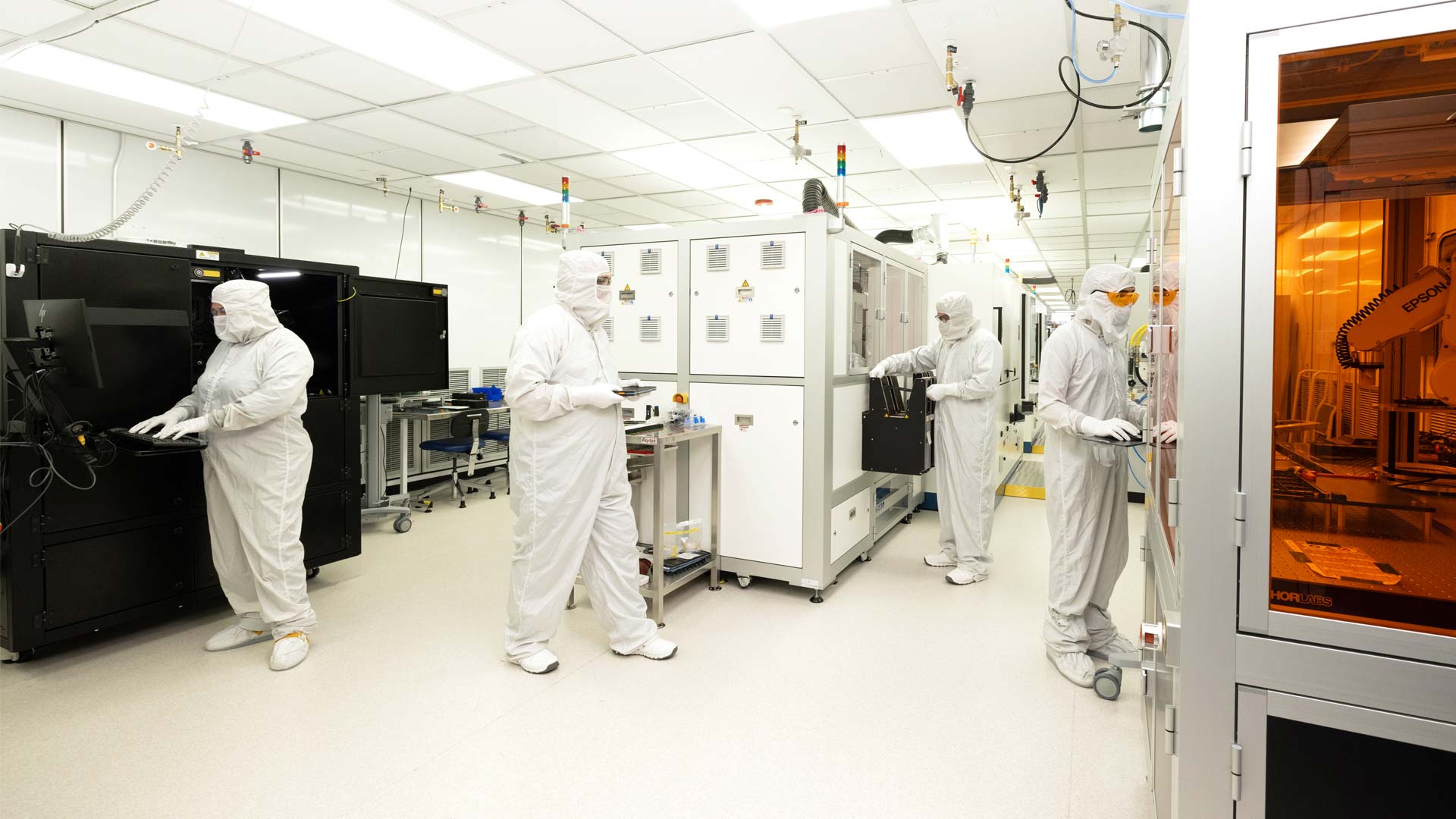
That’s why we don’t treat our light engines and waveguides as separate components. We co-optimize them from the very start with cross-team integration and design. This kind of holistic thinking is one of the key reasons Magic Leap can deliver such high visual quality across different fields of view and form factors. Our teams, including optics, hardware, industrial design, and manufacturing, work side by side to ensure the entire system performs in harmony.
From early design choices to final calibration, this deep collaboration is what transforms complex optical systems into seamless AR experiences.
Why We Co-Optimize Our Components
Every AR visual begins with a light engine that generates the image and waveguides that direct it to your eyes. You can think of the light engine as the source and the waveguide as the path the light takes. If these components are built in isolation, even small mismatches can lead to visible problems like fuzzy edges, inconsistent colors, or fatigue-inducing blur.
That’s why Magic Leap builds both systems in close coordination. We carefully tailor waveguides to the design and characteristics of its companion light engine. And our light engines are engineered with a deep understanding of how their output will interact with the waveguide. This partnership continues across teams and phases of development. Decisions about image resolution, brightness, field-of-view, and even power consumption are made together, not in silos.
This tight integration helps us avoid the kinds of trade-offs and performance drops that can occur when companies rely on off-the-shelf solutions. We don’t do this just to maximize the power of individual components and features. We do it to deliver the most balanced, comfortable experience possible.
Co-Optimization Leads to Proactive Problem Solving
One of the biggest benefits of designing from the inside out is the ability to prevent issues before they ever reach a user. For example, one of the most well-known challenges in waveguide optics is ghosting, faint double images caused by internal reflections. While many systems try to correct ghosting after it appears, our team tackles the problem during the design phase.
By simulating how light will travel through the waveguide, we can predict and reduce these reflections before a single device is built. Sometimes we’ll adjust the geometry of the waveguide. Other times we’ll modify the optical power to subtly soften or redirect unwanted light. These changes aren’t visible to the user, but their effects are. What they’ll notice is a stable image, free of distractions, even in dynamic lighting or fast movement.
This proactive mindset applies to other challenges too, like maintaining brightness across the field-of-view or ensuring sharp focus at different eye positions. When everything is designed together, these issues can be minimized early, rather than patched later.
Matching the Right Tools to the Job
Not all AR devices serve the same purpose. Some are designed for immersive spatial experiences. Others are meant for quick-glance data or communication. That means not every product needs the same kind of light engine or waveguide configuration.
We can rapidly tailor each display system to match the form factor and use case. For instance, a compact device, like glasses, may need to prioritize battery life and size, while a headset for industrial use may emphasize brightness and wide field-of-view. We work with multiple display technologies, like microLED and LCOS-based systems, and test a variety of configurations, including both monocular and binocular formats.
In every case, the waveguide and light engine are tuned as a pair to deliver the right mix of clarity, comfort, and performance. This flexibility lets us build for a range of applications without sacrificing the quality users expect from Magic Leap.
Final Touches Matter
Even after the hardware is assembled, we’re not finished. One of the most important steps in delivering a great AR experience is system calibration. This process ensures that color, sharpness, and alignment are fine-tuned to match human perception.
It’s a step that can’t be skipped. Two devices with the same parts might perform differently without precise calibration. That’s why we invest in fine-detail adjustments across the whole visual system, making sure every image looks clear and crisp.
Calibration is felt every time a user puts on a device and the content appears crisp, legible, and steady.
Built for Today, Tomorrow, and Beyond
AR is evolving quickly, and display systems need to keep up. Our optical components are easily adapted to new prototype styles, so they can be used across multiple product shapes and sizes. That means we can develop future devices faster, with fewer surprises and less rework.
Whether we’re designing for headsets, glasses, or future platforms that haven’t been imagined yet, our system-level approach ensures a strong foundation. It’s a strategy that supports innovation without compromising on comfort, performance, or usability.
We make AR feel effortless. Getting there means building the system from the inside out, so the magic on screen is backed by precision, collaboration, and care you can’t see, but can definitely feel.
Learn more about how Magic Leap designs AR for performance.