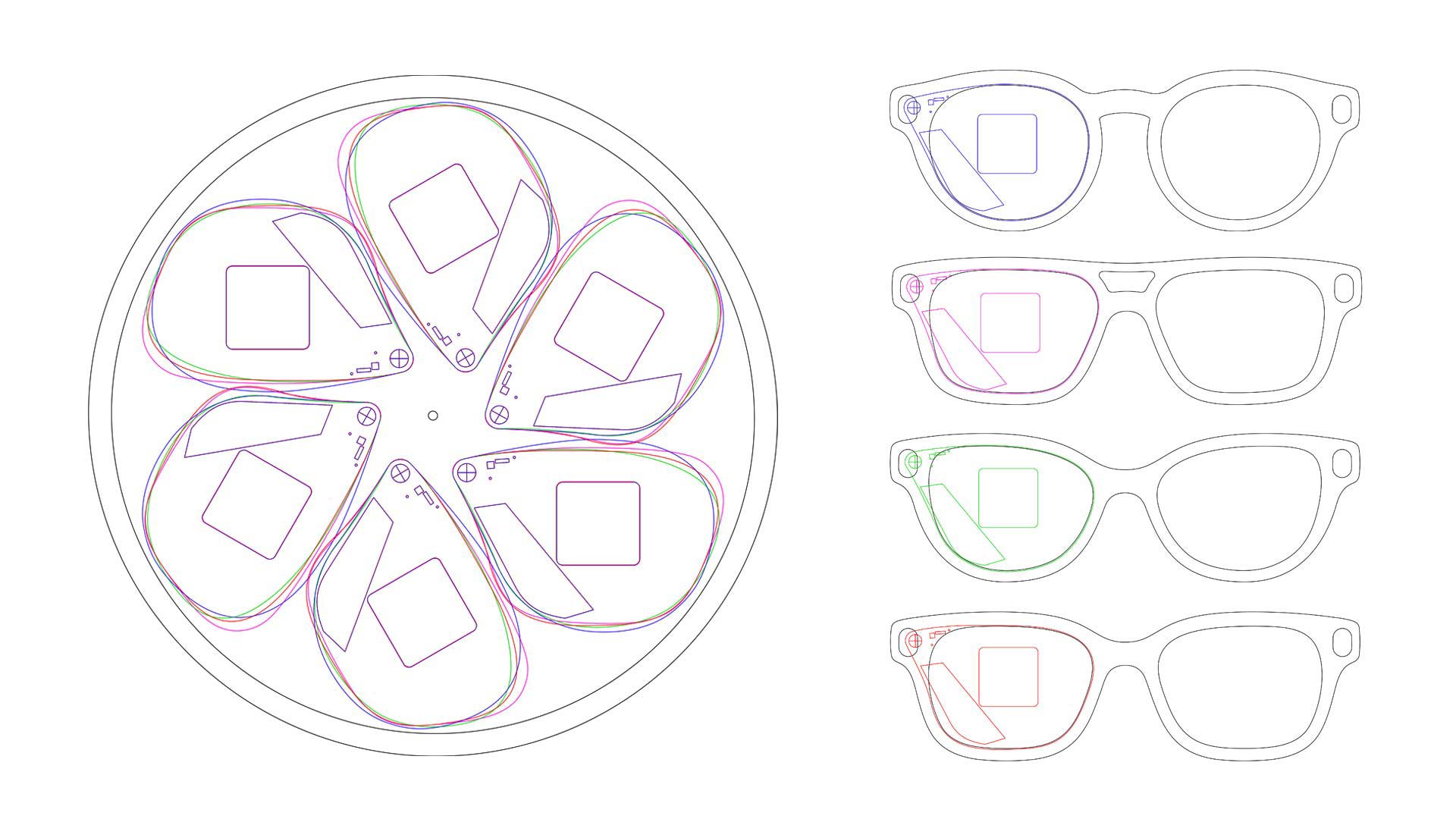
People choose glasses for more than their function. The shape, fit, and style of a frame all influence how we feel wearing it. A pair that looks great on one person might not appeal to another. As augmented reality (AR) becomes part of everyday eyewear, giving people that same freedom of choice becomes increasingly important.
For AR developers, this creates an interesting challenge. How do you offer a variety of eyewear styles without developing an entirely new optical system for each one?
One promising approach is to use a common waveguide design to support multiple finished eyepiece shapes. This allows our partners to explore distinctive eyewear styles without necessarily redesigning the underlying optics for each one.
One Optical Design, Different Shapes
A waveguide uses precisely engineered optical structures to guide light from a projector through a transparent substrate and direct it toward the wearer's eye. These structures, known as surface relief gratings (SRGs), occupy specific regions of the waveguide and control how light moves through it.
Because the entire surface of the finished eyepiece isn't necessarily required for these optical functions, there may be considerable flexibility in its outer shape.
For example, imagine a partner developing a family of AR glasses with both rounded and angular frames. Depending on the optical layout, both styles could use eyepieces produced from wafers with the same optical design, but cut into different finished shapes.
That flexibility can extend beyond the waveguide itself. Different eyewear styles may also share projector positioning, temple geometry, electronics, and other internal components. By preserving these elements wherever practical, we can support meaningful differences in the appearance of the finished eyewear while minimizing changes to the underlying technology.
For partners, that can mean more eyewear styles to choose from, with less engineering work required to develop each new design.
Understanding Where Flexibility Exists
Although a waveguide can accommodate different shapes, that flexibility has some important boundaries.
The optical structures and the paths light follows through the waveguide must remain intact. Some changes to an eyepiece's outer edges may have little effect on optical performance, while others could interfere with how light travels through the substrate or reaches the eye.
The position of the eyepiece matters just as much as its outline. How glasses wrap around the face, the angle at which the lenses tilt, and the distance between the waveguide and the eye all influence the viewing experience.
These relationships help determine whether a new eyepiece geometry can preserve the intended field-of-view, eyebox, brightness, and image quality.
Interestingly, a noticeable change in the appearance of a frame might require very little optical modification, while a subtle change in how the glasses sit on someone's face could have a much greater impact.
Knowing which parts of the design can change, and which need to stay the same, helps designers focus their creativity where it will have the most impact.
Designing with Partners
We've learned from developing waveguides and prototyping AR glasses that optical engineers and industrial designers need to work closely together. A change to an eyepiece's shape can affect how the waveguide performs, how internal components fit together, and how the finished glasses sit on the face. In turn, optical requirements can influence the creative choices available to designers.
Through optical simulation and engineering analysis, we can help partners evaluate proposed geometries and understand which designs may work with an existing optical layout. When changes are necessary, we can explore alternatives and assess their implications for optical performance and device integration.
Importantly, preserving certain optical and mechanical requirements doesn't eliminate creative freedom. There are still opportunities to explore different frame contours, materials, colors, finishes, and other details that give eyewear its distinctive character.
We want our partners to have as much creative freedom as possible, without compromising the performance of the AR display. That starts with understanding their design goals and working together to find practical ways to achieve them.
More Choice, Shared Foundations
The benefits of a shared waveguide design extend into manufacturing. How individual eyepiece shapes are arranged on a wafer affects how efficiently the available material can be used. By considering different geometries early in the design process, we can balance the variety of styles a waveguide supports with the practical requirements of manufacturing.
Producing these different shapes also requires careful attention to how each eyepiece is cut from the wafer. The edges may also require additional processing to remove imperfections and help ensure the finished eyepiece can withstand handling and integration into the eyewear frame. Our experience with waveguide engineering, precision cutting, and edge processing helps us evaluate different geometries while maintaining the optical performance and consistency each finished eyepiece needs.
There's no single style of glasses that works for everyone, and we don't expect AR eyewear to be any different. By building flexibility into waveguide design and manufacturing, we can give our partners more freedom to create glasses people will actually want to wear.
Explore how our waveguide design and development capabilities can help bring your AR eyewear ideas to life.